Monday, April 07, 2008
Dith Pran
 Dith Pran 1942-2008
My Dear Friend,
Peace, love and compassion. You always wished that for others.
You had love and compassion in spades. At the end, I hope you found peace while holding the hand of your cherished Meoun Ser Dith.


Sunday, January 06, 2008
Seeing Machine
And here's another impressive MIT video interview with poet who is going blind called the "Seeing Machine" in which the poet discusses a collaboration between MIT scientists and herself that allows her to see text for the first time in months via images from a computer projected onto her retina.
Elizabeth Goldring is an artist, poet and Senior Fellow at MIT's Center for Advanced Visual Studies. Her collaborative research at CAVS includes visualizing her own vision loss and developing both a visual language and "seeing machine" for people who are blind or visually challenged. This video was produced in collaboration with the MIT News Office in April 2006 as a video news release about Goldring's Seeing Machine Prototype.The video includes excerpts from an earlier documentary produced by Goldring and Ellen Sebring, as well as video art collaborations with Vin Grabill
Music and the Expressive Hand
Also on one of the MIT Media lab's student blogs on Digital Dialogues is quickie sound bite by neurologist Frank Wilson, who Glorianna Davenport says...
...has devoted much of his life to studying the connections between the hand, music and emotional commitment. How can our use of hand create deeper engagement? Does the enormous emphasis on typed text that is so prevalent in today's digital world constrain us? When will tangible digital objects and broader sensory interfaces transform our engagement in the digital dialog and how will this transformation effect our development as artisans and citizens?
Fly With An Eagle

Fly with Tilly the Eagle who is equipped with a web-cam on her wings. In the process you will learn all about eagles in flight and marvel.
I found this wonderful link through MIT's Interactive Experience Group in the MIT Media Lab. Students keep blogs. This blog is called Media Fabrics.
Wednesday, December 05, 2007
Teen Career Video Website
Free Tips & Career Advice from Production Industry Professionals
The amazing 26-year old entrepreneur Joel Holland built up this video career advice website called Kidzonline for teens, while still a student attending Babson University. The videos are free to view and quite interesting.
Here's a video spoof he filmed with Charlie Rose.
Here's an interview with National Geographic's Donna Meir. Holland writes that Streaming Futures is...
......a free, web-based show dedicated to helping teens choose the right career path. We have over 90 streaming video interviews on our site with celebrities, business leaders, athletes, musicians, and career professionals from all different industries.
Hollywood Futures is a free series of videos showcasing short 3-5 minute interviews with hit Hollywood producers, movie studio executives, success production company founders, and others who have risen through the ranks to find great success in the production industry. Interviews are conducted by Footage Firm's Joel Holland.
New interviews are added weekly, so check back or subscribe to the video podcast on iTunes.
Tuesday, December 04, 2007
Coyote Blog
 Photo Copyright Shreve Stockton 2007
 So here's a super-wonderful blog called The Daily Coyote filled with beautiful photos of one photographer's newly adopted pet coyote. Equipped with a fading Canon Rebel she teaches us the lesson that it isn't the equipment that takes the photo. It's the eye and heart of the shooter.
Shreve Stockton, 30, a Vespa rider, tells us
Charlie came into my life when he was just ten days old, orphaned after both his parents were killed. He lives
with me and a tomcat in a one-room log cabin in Wyoming.
You can order prints or calenders of Charlie for $15.95, or an 8x10 print for $45 or pay $5 a month to get a daily feed of Shreve's coyote photos...
This website is an archive of Charlie's daily pictures and my stories of life with a coyote. I post a new photograph every day, but it is a five month lag behind real-time. Subscribe to The Daily Coyote to get current photos delivered to your email inbox.
I wish Shreve the very best. I hope her blog catches on in a viral manner and these semi-micro-payments earn her enough money to support her rural lifestyle and feed Charlie a steak dinner nightly.
Thursday, November 01, 2007
Art Buyers Search Copyright Free Amateur Pix
Adding to my previous post "Anyone Can Be a Photographer" let me show you a query I just received from Guru.com. This art buyer wants to pay someone $1 an image to find copyright-free pix online they can use.
Cheap Art Buyer
Scary indeed. But is fright the proper response? Change is good. Right? Or at least Krishnamurti tells us so. The guys shooting daguerreotypes who were frightened probably went out of business. Those that re-tooled survived. Is there a lesson for everyone in all that?
Cheap Art Buyer
Category: Photography / Videography
Description:
I need someone whom can search for copyright-free photos on the web. I need simple images of presents for a bride and groom (25 of them). They will need to be reduced to about 80 x 80 without loss of quality, and be png format with the alpha channel set to transparent.
An example of a site is flickr.com but you can choose other sites of your choice.
I will pay $1 a photo. I need a fast turnaround. Reply only if you know you can retrieve the photos. I have more work in this area for the competent provider.
Scary indeed. But is fright the proper response? Change is good. Right? Or at least Krishnamurti tells us so. The guys shooting daguerreotypes who were frightened probably went out of business. Those that re-tooled survived. Is there a lesson for everyone in all that?
Wednesday, October 31, 2007
Audio Blogging
Click Here to Hear This Post :
It looks as if my favorite blogging utility, Audioblogger, has been sold or re-cast as a start-up with the new name Hipcast. When I started blogging I often read passages from poets using this easy program. You register, get a code and then phone a number and blog by phone.
Today while singing the praises of this utility I checked out my past posts to send along the info and found that the podcasts didn't work. After searching around I found the Audioblog folks at Hipcast...cool name...with a much bigger agenda. What used to be free is now $9.95 a month. But you can sign up for a fee one week trial.
Think about it as marketing tool. Blog a thought or tip each day by Hipcast , calling in by phone. Then put that link on your website or in the signature line of your e-mail messages.
Blog By Telephone
Hipcast now offers three new ways to upload audio. By telephone
Record Audio Through Your Web Browser
Or Upload Audio files
It looks as if my favorite blogging utility, Audioblogger, has been sold or re-cast as a start-up with the new name Hipcast. When I started blogging I often read passages from poets using this easy program. You register, get a code and then phone a number and blog by phone.
Today while singing the praises of this utility I checked out my past posts to send along the info and found that the podcasts didn't work. After searching around I found the Audioblog folks at Hipcast...cool name...with a much bigger agenda. What used to be free is now $9.95 a month. But you can sign up for a fee one week trial.
Think about it as marketing tool. Blog a thought or tip each day by Hipcast , calling in by phone. Then put that link on your website or in the signature line of your e-mail messages.
Blog By Telephone
Hipcast now offers three new ways to upload audio. By telephone
Call a number, speak your mind, hang up. From anywhere you've got a phone*. From the club, the game, in traffic, at the mall, at a trade show, you name it. Talk up to 60 minutes. Interview someone or even record a conference call.
Record Audio Through Your Web Browser
Have you recorded and produced audio using one of the numerous software programs like Audacity, GarageBand, Soundtrack, CoolEdit/Audition? Are you a musician that's created a new track you want to share? Upload files up to 250 MB in size and publish. It's that easy. We support most audio formats.
Or Upload Audio files
With a simple computer microphone and high-speed internet access, you can record high-quality audio right through the web browser, with no additional software needed.*
Monday, October 29, 2007
Linking Video To Your Website
Do you want to embed a video player into your website without writing lengthy and complicated HTML? One typo in HTML code and it doesn't work, right? And if you're a poor typist like me...
Here's a page on The University of California's website where you can easily create an Embedded Media HTML Generator.
And you can read all about delivering video from your website at EventDV.
Here's a page on The University of California's website where you can easily create an Embedded Media HTML Generator.
And you can read all about delivering video from your website at EventDV.
Monday, February 26, 2007
My Gifted Dad

 I watched the Oscars last night with my father, 86. It's an emotional time as he packs up his apartment to go into assisted living near my brother. After eating Vietnamese take-out we settled into two unpacked office chairs amidst piles of boxes to watch TV.
 In 1963, during a brief respite from an illustrious career as a still photographer, my father was Director of Photography for the film, "Lord of the Flies". The renowned British stage director, Peter Brook, asked my father to shoot this award-winning film and gave my father ten days to learn to use a movie camera before film production began on the island of Vieques. My father had never touched a movie camera before.
The rest is history. My father, a genius of sorts, developed a whole new system for tracking and zooming. He created a gate that swung and panned along the actors as they moved. In fact Tyson Kubota, a film student at Dartmouth, recently posted this critique of my father's shooting technique. I don't think he knew about Dad's swinging gate.

First, some technical lessons:
Zooming may not be so bad after all! The cinematographer Tom Hollyman (trained as a still photographer, Lord of the Flies is his one and only credited feature film) claims that this was the first feature ever shot [entirely?] using a zoom lens. He explains an efficient technique used for camera movement: walk at a right angle to the subject and pivot the camera/zoom in slowly to create a faux-dolly effect: this allows one to continually vary the background to obscure the fact that you’re zooming (so you’re not zooming in on the same spot, which is the core reason why static zoom-ins often look ‘cheap’).
Zooming Back to Puerto Rico
Brook and my father worked in the second floor of our apartment in Puerto Rico to develop Dad's tracking technique. If you look to the left of this photo you can see me watching.
 If I look solemn it's because maybe I felt the production of this movie was a family affair in which everybody but me played a role. Perhaps I took the constant commands for " All Quiet On Set!" too personally.
  My brother Burnes, an extra, shown here, behind his father's camera, played Douglas, while my Mother took stills and helped with casting. I flirted with the Surtees twins and did get to play a stand-in for Piggy while my father learned to use a movie camera by making tests. Click here to see a slideshow of some low res pix of my father at work with Peter Brook.
 Last Night
During a commercial break in the Oscars last night I asked my father why he didn't get further into film-making after " Lord of the Flies."
He said that after shooting Lord of the Flies he realized how much there was to learn in the craft of cinematography and that he felt he was too old at that time to begin at the bottom, learning the craft.
Kubota on Dad
Kubota continues in his critique:
On improvisation:
Famed director theater director Peter Brook got these non-actor children to convincingly live the experience of their characters—he reportedly shot over 60 hours of footage. Onscreen I could sense the free, wide-open editing process this approach must have allowed him. Each shot, no matter how briefly held, has a unique richness, an eloquence and brevity that comes from a confluence of unpredictable factors: the child performers, the environment, weather and lighting conditions, not to mention everyone behind the camera and offscreen.
The precisely exposed, carefully modulated tonalities contrast with the sense of contingency and spontaneity in the framings and actor movement. The way Hollyman/Brook shoot faces is particularly inspiring: the frequent close-ups on faces with starkly lit sky backgrounds or negative space decontextualize each boy’s position in the narrative, imbuing each image with a mythic weight (I could sense the cinematographer Tom Hollyman’s background in still photography most strongly in these moments).
The film is also a masterclass in the efficient and effective use of location shooting. The film’s power comes from the aesthetic tensions it contains: between the boys’ completely ‘real’ physical ‘performances’ (their physical presence in the actual conditions of the narrative) and the almost-entirely-postdubbed dialogue that they ‘speak’; between the gritty, pocked texture of the hunters’ volcanic rock fortress and the smooth grey tones of the open sky; between the use of unexpectedly disjunctive shot compositions and editing rhythms and the supple gliding camera movements; and between the occasional music (almost always used ironically or as thematic counterpoint, never in a conventional melodramatic sense) and the ambient beauty of the rest of the naturalistic sound design. The overall attention to detail and affect is staggering; I am convinced that Brook’s daring formal approach was the perfect choice to balance the broad-strokes allegory of Golding’s storyline.
Strut Your Stuff Dad @ The Heritage
Hey Dad...Someone's blogging about work done some 36 years ago--if all of us could be so lucky. Kubota says the film is a "masterclass in the efficient and effective use of location shooting."
So Dude, listen here. You may be difficult. But you're also gifted.
You're a true Technoratti presence. Cool enough. The ladies at the Heritage will surely swoon when you show them Kuboda's blog post.
Way to go.
I be proud.
Saturday, February 24, 2007
Deadly Fake Anti-Malarial Drugs

Photograph Copyright Stephenie Hollyman
Click Here to View Slideshow on the anti-malarial wonder drug, made from artemisinin. This herb, also known as wormwood is now being grown in Tanzania by Awaarusha farmers. Photos Copyright Stephenie Hollyman 2007.
Indeed my heart sank yesterday while reading In the World of Life Saving Drugs, a Growing Epidemic of Deadly Fakes, in The New York Times Science Times , which says that in Southeast Asia " 53 percent of the antimalarials bought were fakes."
Estimates of the deaths caused by fakes run from tens of thousands a year to 200,000 or more. The World Health Organization has estimated that a fifth of the one million annual deaths from malaria would be prevented if all medicines for it were genuine and taken properly.SLIDESHOW ON ARTEMESIN“The impact on people’s lives behind these figures is devastating,” said Dr. Howard A. Zucker, the organization’s chief of health technology and pharmaceuticals.
Internationally, a prime target of counterfeiters now is artemisinin, the newest miracle cure for malaria, said Dr. Paul N. Newton of Oxford University’s Center for Tropical Medicine in Vientiane, Laos.
If you click above you can view a slideshow of photos I took in Tanzania of a village where the live-saving herbal plant artemisin annua is being grown in Tanzania.These photos are part of my ongoing multimedia project on malaria called " Fever Zone". Also include ( the white folks) are photos of agri-biz growing artemesin in Tanzania.
FIRST HAND EXPERIENCE: GETTING SICK
I asked the nurse at the clinic to test my blood for malaria and continued working.
One half hour later the clinic's doctor approached me laughing, saying that I must take my subject matter--malaria-- quite seriously, because I had caught it. " Welcome to Tanzania" he boomed out as he wrote me a prescription for artesunate pills.
My WHO driver took me to a reputable pharmacy where I bought this life-saving medicine before retreating to my hotel to recover. After sleeping around the clock between taking pills during what became my malarial " Lost Weekend" I awoke on Monday. Weak but recovered.
By Tuesday I was back at work. I was lucky. If I had taken counterfeit artesunate I might have died. With excellent reporting Donald G. McNeil Jr. details the peril in which these counterfeit drugs place their users.
Many of the fake artesunate pills found by Dr. Newton’s team were startlingly accurate in appearance — and much more devious in effect than investigators had suspected.Not only did the pills look correct, as did the cardboard boxes, the blister packing and the foil backing, but investigators found 12 versions of the tiny hologram added to prevent forgery.
In one case, even a secret “X-52” logo visible only under ultraviolet light was present, though in the wrong spot.
Another hologram was forged by hand, Dr. Newton said, by someone who obviously spent hours with a pin and a magnifying glass making tiny dots on a circle of foil to imitate the shimmer.
But the most frightening aspect appeared when the pills were tested. Some contained harmless chalk, starch or flour. But the latest, he said, contained drugs apparently chosen to fool patients into thinking the pills were working.
Some had acetaminophen, which can temporarily lower malarial fevers but does not kill parasites. Some had chloroquine, an old and now nearly useless antimalarial.
One had a sulfa drug that in allergic people could cause a fatal rash.
And some had a little real artemisinin — not enough to cure, but enough to produce a false positive on the common Fast Red dye test for the genuine article.
Those would not merely fool a laboratory, Dr. Newton noted. They could also foster drug-resistant parasites, so if patients were lucky enough to get genuine artemisinin treatment later, they might have already developed an incurable strain and could die anyway.
Such resistant strains could spread from person to person by mosquito and ultimately render the drug ineffective, as already happened with chloroquine and Fansidar, two earlier malaria cures.
“We make no apology for the use of the term ‘manslaughter’ to describe this criminal lethal trade,” Dr. Newton and his co-authors said last year in an article in The Public Library of Science Medicine. “Indeed, some might call it murder.”
Friday, February 09, 2007
Multimedia Dogizens
I just read an interesting post called The Pedigree of Goodness . It's a must read for those involved in working in teams on multimedia projects. It really brings home people's need for validation and the need for team-mates to acknowledge colleagues' contributions.
She writes..
She then deconstructs the notion of goodness...
She writes..
Perhaps you have seen the latest Pedigree dog food commercial? In it, the camera pans on a series of ordinary looking dogs in a dog pound, and the voice-over gives them language. The dogs say things sequentially like "I don't know where I am..." "And I don't know how I got here..." "but I know that I am a good dog..." "And I just want to go home."
She then deconstructs the notion of goodness...
And, like the dog in the pound, at the core place in our hearts all any of us really want is to find whatever reads out as h-o-m-e for us, and to be able to be there.
The dogs in the commercial want to be seen, to be noticed and ask to be acknowledged for what it is they have to give. They are the quintessential Everyperson.
Saturday, November 25, 2006
Not Madonna's Malawi
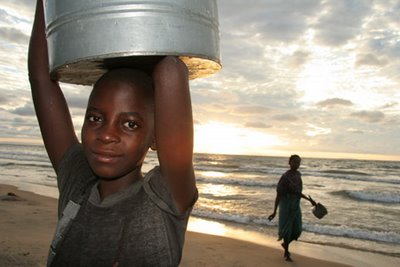 Photograph Copyright Stephenie Hollyman 2006
We all read about Madonna's "adoption" of a child from Malawi last month. It was probably the first time most have read about Malawi in the paper. Which just goes to show you the power of celebrity to sell news. In June you may have read my post about Brangelina selling toothpaste.
Here's a link to photos I did in Malawi in 2005 on malaria as part of my multimedia work in progress " Fever Zone."
Here, Families of Yao fishermen live in small villages along the shores of Lake Malawi, a reagion that has one of the highest rates for malaria in the world. For residents here, an attack of malaria is as common as flu to a resident elsewhere.
For although we read almost daily about the scourge of AIDS in Africa it is also a fact that malaria kills an African child every 30 seconds. Almost 97% of Malawi's population is at endemic risk for malaria. Children under five suffer on average 9.7 malaria episodes per year, while adults suffer 6.1 such episodes.
Families in Malawi can spend almost a quarter of their small annual income treating malaria. Malawi is one of the world's poorest nations in the world with a 37 year old life expectancy at birth for women and 36 for men.
Sunday, November 05, 2006
Brian Storm's Mediastorm
Last Fall MSNBC.com won exclusive internet rights to MediaStorm’s production, Iraqi Kurdistan by Ed Kashi. The private online auction ran for four days and was conducted at http://mediastorm.org. Participants included news, lifestyle and arts publications from around the world. MSNBC.com premiered the project on November 13th, 2006.
Since then Brian Storm has been producing and uploading exciting multmedia packages on his site. Check out Kristen Ashburn's BLOODLINE: AIDS and Family,
in which video and photos are combined with audio to create a moving cross media document. Visitors are greeted by a mother who addresses them directlt from a player window:
Since then Brian Storm has been producing and uploading exciting multmedia packages on his site. Check out Kristen Ashburn's BLOODLINE: AIDS and Family,
in which video and photos are combined with audio to create a moving cross media document. Visitors are greeted by a mother who addresses them directlt from a player window:
I said, my children, you know what I have HIV. One day I will die and leave you my children. So you must be brave and look after yourselves and look after me.
Saturday, November 04, 2006
Rich Media Sells Cars
 Photograph Stephenie Hollyman 2005
At Photo Expo yesterday I was chatting, briefly, with Holly Hughes, Managing Editor of Photo District News, about multimedia and Brian Storm's exciting new venture MediaStorm.org which just auctioned off a rich-media story package for the first time to MSNBC online, two days ago. I asked Holly if anybody was making any money yet from producing media-rich stories. She shook her head and said, " Not yet."
Nissan Sells Cars With Rich Interactive Media
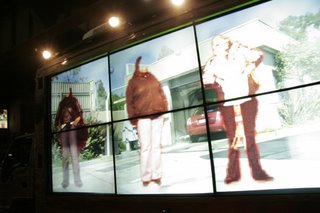
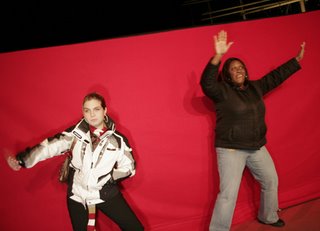
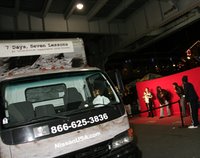
That may be true for photographers but the ad agencies working for Nissan seem to be doing OK. When I returned home, people were dancing across the Street at the Seaport Museum, prancing on a red backdrop in the cold, in front of a van where their images were being projected onto a grid of video screens. Grunged type on the truck read " 7 Days, Seven Lessons, An Interactive Experience from Nissan." It is all part of a five-city cross media campaign produced by All Points Media to promote Nissan's latest model Sentra car to young urbanites.
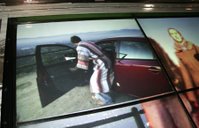 The agency hired Marc Horowitz, to shoot in a You-Tubey manner, The Tennessean tells us
"a California-based performance artist and photographer's assistant, and the trials and tribulations he experienced while trying to maintain a normal life living in the car for a week in Los Angeles... Besides Web logs, a My Space page and online videos, the company also bought an online "island" in the fast-growing virtual reality game SecondLife..."We shot it in what we call 'reality plus,' " said Rob Schwartz, executive creative director for Nissan's primary ad agency, TBWA\Chiat\Day...The result is a $40 million to $50 million advertising campaign that includes seven different television commercials, a variety of print ads, at least three Web sites, a couple of blogs, 15 "Webisodes" and a spot in an online computer game, where players can get their own virtual reality version of the Sentra to drive around cyberspace (where they'll see virtual Nissan billboards, too).
Cool Cars With Plugs for iPods & Bluetooth Technology
 Here at South Street Nissan's newest Sentra was parked next to the van. A " Product Specialist" invited a passing tourist named Stacy to check it out. Stacy, who owns a 2005 Sentra, settled into the car's roomy front seat. When she was told that the car had Bluetooth wireless technology and that she could plug her IPod into the car's speakers, controlling the volume at the steering wheel, she shouted out " Get Out! I love everything. It's a toy!"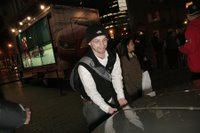
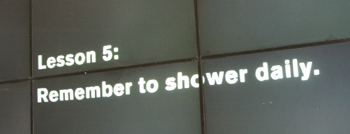 Stacy now headed for the red backdrop where she watched herself moving as part of the " Lesson 5: Remember to Shower Daily" episode that played on the large screen on the van. A small web cam picked up her movements and projected them back as on the screen.
  Her interactive "real time" guide Alonzo Wilson, from Oregon's All Points Media told Stacy he was going to " Fog". After a flick of Alonzo's remote wand, Stacy saw Eric on the screen telling us that he needs a bath and is going to the car wash. Fog enveloped each of the squares in the screen. Alonzo instructed Stacy to " wave" it away which she did with a flourish.
Nissan has built a faux site on My Space for Marc, including videos and PDF files vistors can download.
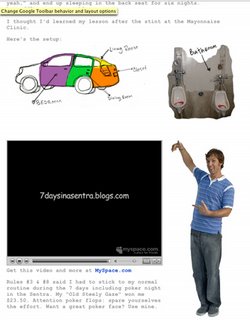
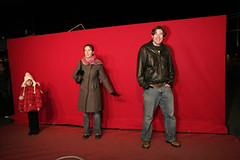 Photo Stephenie Hollyman
But there are perils along this path warn experts.
"That lack of authenticity … can come back to haunt the advertiser," warns adman Garfield. "It's a real obsession with those who live online. They don't like people playing with their minds."
Tuesday, October 31, 2006
Pencil Hollyman The Devil Dog
 Photograph Pencil Hollyman
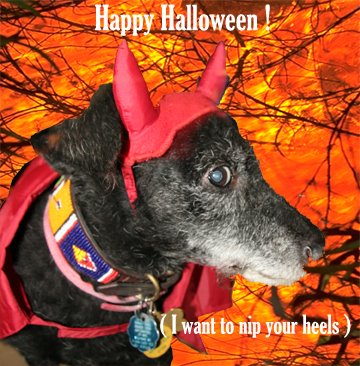
Yes, it's true. Cindy Sherman lived down the hall from me in a loft here at South Street when she was just starting out. So inspired, my rescue dog, Pencil likes to dress up and have his photograph take in different roles, even though I tell him that he's a bit derivative. You may have read the previous post where he dressed up as a Bollywood star.
Derivitive or not, he knows I've been a slacker as of late on posting on this blog, too busy with other work. But he is persistent. So he nuzzled me awake this morning with a poke of his pointed nose, all dressed for Halloween in his Devil Dog Suit. He asked me to take this picture.
So Happy Halloween from this girl and her dog!
Sunday, October 01, 2006
Festivus & Allen Salkin
I mentioned Allen Salkin, the freelance writer with whom I worked last week on a NYTimes assignment. Do check out Allen's website " for the rest of us", Festivus. Salkin tells us there,
Salkin's site tell us that
This is the home for all things Festivus, the holiday most people believe, wrongly, started on an episode of Seinfeld. This Website was set up by the author of Festivus: The Holiday for the Rest of Us, the book which shows in hilarious and 100 percent accurate detail the stunning, bizarre and sometimes controversial ways real people all over the world are actually celebrating Festivus now.
Salkin's site tell us that
Allen Salkin is an investigative reporter. He is the author of the book Festivus - The Holiday for the Rest of Us.
Allen has written on subjects ranging from the last true waterbed salesman in the San Francisco Bay Area to corruption in the Brooklyn courts for The New York Times, Details, Yoga Journal, Heeb, and other publications.
Allen has been a rubber ducky salesman in Las Vegas, a farm laborer in Crete, a casting agent in Hong Kong, a busker in Melbourne, a stand-up comedian in New York, a cafeteria cashier in Squaw Valley, a slacker in San Francisco, and a chocolate chip cookie maker in Waikiki.
For Allen's blog, journalism and photos, visit his website: www.allensalkin.com.
Magic Flute Glow
 Photograph Stephenie Hollyman Copyright 2006
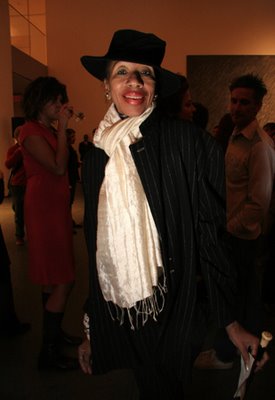
Here's another example of my Magic Flute operatic lighting using Gary Fong's light dome with my Canon 580EX flash off camera. This was taken last week for a New York City museum.
In a previous post I spoke of letting ambient light burn in with the flash exposure to warm up a subjects'face, to produce a glow. For this portrait of elegance and elan I held the flash low and to the left, shooting with a slow shutter speed.
Operatic Footlighting
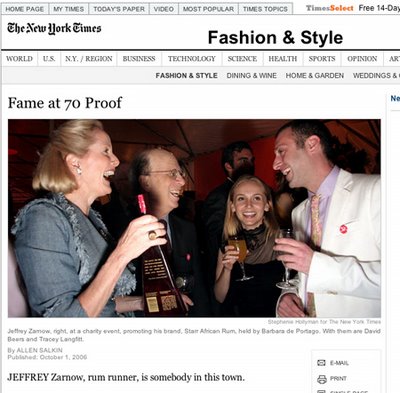
If you have read my previous posts on Gary Fong's Light Dome you know what an unabashed fan I am of the effects it can produce, when used off camera axis. This last week I shot three evenings for The NY Times for a story called "Fame at 72 Proof." I worked with the tremendously talented and charming Allen Salkin, who is among many other things, the author of the book Festivus. Our assignment was a story about owners of boutique liquors and how they promote their product by donating their branded booze to hosts of high profile parties and events.
To take this shot of the maker of African Starr Rum, Jeffrey Zarnow, I used Gary's Fong's diffused milk-white dome instead of the translucent version over my Canon 580 EX flash. This cone-like covered dome really produces a nice soft white light. But don't count on using it for subjects far away. The fall off is incredible.
I held the flash with the light sphere low, using the flash to emulate a footlight at the opera. I call this my " Magic Flute"effect...sort of like when Pappageno ( sp?) plays his flute.
Careful though. Doing this can cast wicked shadows. Check your screen " chimping" after each shot to make sure you have it in the can. Try to get the subjects away from walls where shadows' " hash marks" will land. Or if you do have a wall, place the flash so the shadows become a crafted part of the photo.
Shake and Bake Event Photography
 Photography Copyright Stephenie Hollyman 2006
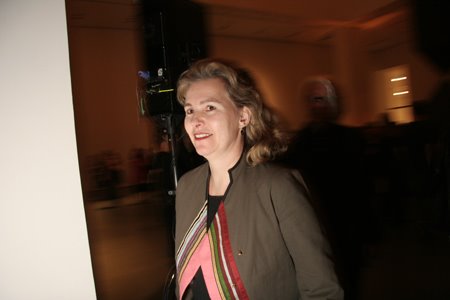
Last week while shooting an event for a major New York City Museum I played around with what I like to call " Shake and Bake " photography. No, I don't sprinkle seasoned bread crumbs over my subjects. I shake the camera as I shoot a long time exposure and let the ambient light " bake" in...while a nano-second pop of the flash produces an occasional surprise or two.
I set the white balance for the flash rather than putting an organge gel over the flash and setting the white balance for tungsten. It makes everything glow warmly and orange in the background. But the subjects in the foreground come out correctly balanced.
But do beware. There is an element of digital voodoo at work here. The ambient back ground blurs and the subjects lit by flash stand out in sharp relief...if you're lucky. So play it safe and take the standard shot before shaking your camera camera around for the next one.
And set your flash to overpower the ambient light by one stop. Otherwise your the orange from the tungsten will " burn" in to the exposure on your subjects' faces and make them look like pumpkins. ( Although occasionally I will warm up a pale subject by lengthening my shutter speed to allow a " glow" to burn in under the flash exposure.)
Monday, August 28, 2006
Vote For Spoiled Yappy Dog For Congress
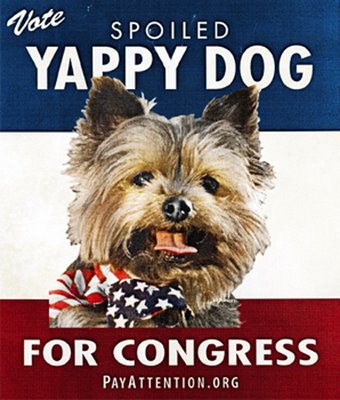
Click here to see, hear and interact with Spoiled Snappy Dog's campaign For Congress. Forward the link to this post and become a foot soldier in an incredibly clever viral campaign sponsored by the Ad Council to get out the youth vote in November. Listen to the radio ad for Spoiled Yappy Dog for Congress or download and print out a campaign materials such as a PDF file of Spoiled Yappy Dog for Congress to iron onto a tee shirt.
Listen to the stirring voice-over narration telling us the little known facts behind the candidate, " Born the youngest of 15, Spoiled Yappy Dog made overcoming adversity her first order of business. From day one she's had an agenda to get things done. Protecting our youth and fighting the good bites she's never chased after special interests, only mail trucks..."
If you visit the home page
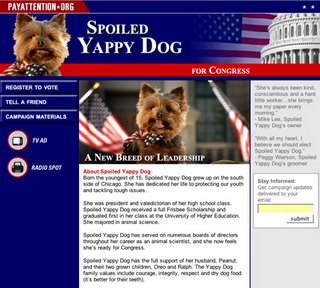 for Spoiled Yappy Dog at www.payattention.org you can also download PDF files of Spoiled Yappy Dog For Congress that can be printed out as door hangers.
 And you can also read the latest news from the campaign trail of Spoiled Snappy Dog. This hot item just in from Rochester New York:
Too Gosh-Darn Cute
ROCHESTER, N.Y. - A recent newspaper article accused Spoiled Yappy Dog of making puppy dog-faces and flirting with the press in an attempt to win votes. Spoiled Yappy Dog’s supporters are calling it ridiculous. “Spoiled Yappy Dog is a professional. What does she have to do to be taken seriously around here? I just can’t believe voters are really that superficial,” said Tom Jones of Appleton, N.Y.
A spokesperson from Spoiled Yappy Dog’s camp said, “Her record speaks for itself,” and that “sooner or later people will know that her bark means business.”
Well done Ad Council!
Thursday, August 03, 2006
Photo Essay: Of Tugs & Ship Docking
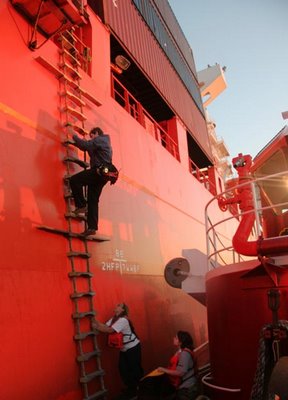
Click here to play slideshow of ship docking photos
After a summer solstice hiatus am back to blogging...
A freelance life is never dull. I took last weekend on a New York harbor docking master, Captain Jeffrey McAllister. Jeffrey is the fifth generation of his family to bring tugs in and out of the port of New York. Photos copyright Stephenie Hollyman 2006.
To take the pix I spent the night on board the Robert E., a Navy tug converted to a sea-going tractor tug. Climbing down rope Jacob's ladders, and up and down ship's gangways with Capt. Jeff, I tried to catch a mini-portrait of tugboat life with my camera.
As one of the first women to break into New York harbor as a tugboat cook some long time ago, I was heartened to find that the Robert E. had a female deckhand, King's Point cadet and Mate at work. They did a great job and seem to be fully integrated into the fleet. It's no big deal for the guys either. It goes to show you that sometimes things do change.
Over the years the years I have been sponsored by captain Brian McAllister to write a history of his family's 142- year-old company, upon which now I am putting the final touches.
Sunday, July 23, 2006
Neil's Tip for Better Flash, Burn & Pan Pix
 Photograph Stephenie Hollyman
Do sometimes you favor flash, pan and burn photography? If you are like me, you set your flash on manual and use a long shutter speed. Then setting your camera on first curtain sync you pan and blur the back ground. You cross your fingers and pray then check the LCD screen to see if you caught the moment.
I took this photo last week while shooting an event for a major museum. Towards the end of evening after I had taken the " safe" pictures required for any event I stationed myself by the stairway and panned at a 1/15 of a second as people whisked by, pointing my off camera flash to the side, clad with its Gary Fong Light Dome.
Neil Turner maintains one of the most helpful websites, dg28.com I have found re lighting. If you click on Lighting Technique you'll find answers and how-I-shot-the-assignment examples for many of the technical conundrums we all face daily trying to make silk from a sow's ear when a subject isn't that interesting visually.
All of us have played with this. Sometimes it works, sometimes not. We have learned to use this as a " toy", after getting the shot we know we want for sure. Here's a tip from Neil to raise the ante so that your next flash, burn & pan (FBP) shot becomes a keeper.
Neil's Flash Burn and Pan Tip
Neil tells us to keep the flash off camera so the subject has some shadow over which the ambient light can blur. Then he tells us when we pan to move the camera TOWARDS the light. That's how I took the picture above.
You compose the picture and during the relatively long exposure you deliberately move the camera. This one was left to right. You need to move the camera towards the flash in most cases. The ambient light then blurs and the subject is frozen where the flash catches him. It's good if the flash is off camera because the effect is strengthened by the subject having some shadow on him, over which the ambient can blur. This is done entirely "in camera" and requires no photoshop alteration. With a digital you can check what you've done on the screen and alter the light balance/direction of movement/angle of movement accordingly. I originally learned to do this using transparency film and a lot of it! I also tend to explain to the confused looking person that it's a technique to move the camera, otherwise you may have them thinking you're a bit mad!!
Saturday, July 22, 2006
Cooking Up a Wi-Fi Range Extender
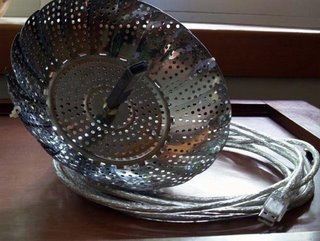
We all love digital technology. But after assignments, editing the photos sure does take time. I like to sit on sofa with my Mac Powerbook networked via wi-fi to an Airport Express module that also connects to my desktop Mac. But sometimes the signal is weak.
So check this out. No joke. I couldn't believe it when I saw it this morning on the blog for Make Magazine. Here are the instructions for making your very own wi-fi amplifier from a vegetable colander.
Tm36usa writes "Easily receive WIFI signals from far away using a standard USB WIFI adaptor and a bit of ingenuity. This Simple idea requires no modifications to a USB WIFI adaptor or your computer. A simple way to increase the signal strength and range of your WIFI. Plus it works with all USB WIFI adaptors".
On the same blog you can also learn how to make a rodent powered night light or image transfers of photos using solvents on cloth and other non-traditional media.
It's raining out there so get thee to thy workshop and help banish weak wi-fi signals at home. ( and let me know if it works)
Wednesday, June 28, 2006
International Mix Tape Project: Analogue!
Thanks to ITunes I listened to my CC ( Cool Cat) neice Helen, on Saturday, in New Orleans, as she served as DJ in her weekly radio program at Tulane University. Her voice was as silky as it was smooth. And this production was certainly no Prairie Home Companion in its inception, completly digital instead. So very very hip.
Even Helen's grandfather listened from his I-Mac.
Remembrance of Things Past...Living In an Analogue Environment
But this all set me musing. There's a scene in Praire Home Companion in which a character plays a vinyl record in his dressing room that makes you think " How quaint."
Yes, you have your IPOD and are hip and groovey. But are you a closet digeratti who yearns for a walk along the pathways of a less hectic time? Is a networked life tethered to a Blackberry making you increasingly anxious? Do you long for those days when meetings took place offline where smiles and laughs were real not LOL?
Do you miss analogue technology, a gentler era when music mixes were made with cassette tapes instead of computers and you, (as Daily Candy posts today) passed..." Hours spent astride double decks, fingers poised above the pause button, timing each song (juuust right), with a little MC magic added to the mix."
Fear not. Today's sweet dose from Daily Candy describes a charmingly quaint and retro society of music mixers who trade casette tapes by snail mail. By joining the...
You can find out more about the IMP at BBC Online.
Even Helen's grandfather listened from his I-Mac.
Remembrance of Things Past...Living In an Analogue Environment
But this all set me musing. There's a scene in Praire Home Companion in which a character plays a vinyl record in his dressing room that makes you think " How quaint."
Yes, you have your IPOD and are hip and groovey. But are you a closet digeratti who yearns for a walk along the pathways of a less hectic time? Is a networked life tethered to a Blackberry making you increasingly anxious? Do you long for those days when meetings took place offline where smiles and laughs were real not LOL?
Do you miss analogue technology, a gentler era when music mixes were made with cassette tapes instead of computers and you, (as Daily Candy posts today) passed..." Hours spent astride double decks, fingers poised above the pause button, timing each song (juuust right), with a little MC magic added to the mix."
Fear not. Today's sweet dose from Daily Candy describes a charmingly quaint and retro society of music mixers who trade casette tapes by snail mail. By joining the...
International Mixtape Project, you can tune into a growing community of global headphone hipsters who trade old-school tapes (and compilation discs) via snail mail.
Every month you swap your precious song compilations with music-minded pen pals around the world. Imagine! Your mix prowess heard from Helsinki to Beijing! And it’s just a few stamps away.
At the moment, 30 countries are exchanging beats: Israeli microhouse, Nova Scotia neo-soul, Bay Area hip-hop, and Congolese electro-folk.
Joining is simple and membership responsibilities are few (thank goodness, because summer heat makes us l-a-z-y). Cover art isn’t a must — but hello! — it’s, like, totally the best part.
And it just might save your life.
For reel.
You can find out more about the IMP at BBC Online.
Monday, June 26, 2006
Cisco Videos

Cisco has created a splash page comprised completely of video clips to sell their product Cisco Unified Communications. Visitors to the page can click on one of ten video clips or choose to view a video categorized by...yes, sigh... " solution". Heard that word before?
Web 2.0 Podcast
In a BusinessWeek podcast O'Reilly Media CEO Bill O'Reilly discusses Web 2.0 , and the the architecture of participation. Here where users create the content, design helps leverage the flow of collective information.
There's no buzzword more popular in tech today than Web 2.0. Conceived during a brainstorming session for what became the Web 2.0 Conference now held annually by O'Reilly Media Inc. and CMP Media, Web 2.0 describes the new online services such as the volunteer-written encyclopedia Wikipedia, Yahoo's Flickr photo-sharing site, online marketplace eBay, and search engine Google. Unlike most of the first generation of Web sites, these services have an innate social component, often "harnessing collective wisdom," as O'Reilly Media CEO Tim O'Reilly puts it.
Thursday, June 15, 2006
YIKES: Video Vixen Link Not Mine!
VIDEO VIXEN NOT ME!!!!!
YIKES!
I just found that the link to the blog I created to archive my video posts called "Video Vixen" leads to a blog maintained by another Video Vixen, this one named Joan.
The code for the sub-blog " Video Vixen" where I archive posts about video uses a hyphen in its URL. Joan the OTHER "Video Vixen"...NOT ME...does not.
Self publishing without oversight of a copy editor is a life fraught with peril indeed. Even as I post this I am blushing. If you were to check out Joan's blog you would see why.
How Did This Happen?
A while back I changed the template on this blog, Crossing Media and re-tagged tagged the links myself from memory to MY "Video Vixen." Big mistake. I left out the hyphen. Even bigger mistake I never checked all the links after republishing Crossing Media with the new template. DUMB.
Sorry folks! Next time you see something like that...please let me know!
YIKES!
I just found that the link to the blog I created to archive my video posts called "Video Vixen" leads to a blog maintained by another Video Vixen, this one named Joan.
The code for the sub-blog " Video Vixen" where I archive posts about video uses a hyphen in its URL. Joan the OTHER "Video Vixen"...NOT ME...does not.
Self publishing without oversight of a copy editor is a life fraught with peril indeed. Even as I post this I am blushing. If you were to check out Joan's blog you would see why.
How Did This Happen?
A while back I changed the template on this blog, Crossing Media and re-tagged tagged the links myself from memory to MY "Video Vixen." Big mistake. I left out the hyphen. Even bigger mistake I never checked all the links after republishing Crossing Media with the new template. DUMB.
Sorry folks! Next time you see something like that...please let me know!
Wednesday, June 14, 2006
Podcast: Race and NYC Ad Agencies
Ad Age really gets the Cross Media thing. They encode their video for a Flash 8 player which I now think is the way to go. And check out this podcast in which reporter Lisa Sanders talks her story Race and the New York City Advertising Industry An Update on the Human Rights Commission Investigation.
NEW YORK (AdAge.com) -- Ad Age reporter Lisa Sanders provides an overview and update of the New York Human Rights Commission's investigation of Madison Avenue diversity hiring practices. Both the Commission and the City Council's Civil Rights Committee are planning to hold public hearings on the issue. In the latest move, the Commission has issued subpoenas for 16 of New York's top agency executives.
Tuesday, June 13, 2006
Scooterati: Ironbound Rally
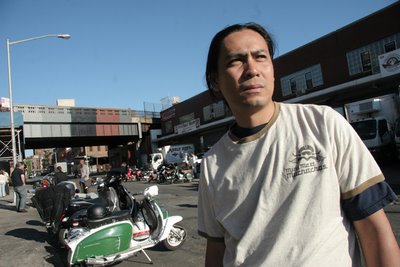
Here is another set of photos from Saturday's Scooter block party, as members drive in a rally from New York's Brass Monkey to Newark's Ironbound district.Click on the upper right hand link on the Flickr set page to see the pix as a slideshow.
Brouhaha's Video: The Finals of the Slow Race
Here also is a video shot during last weekend's Scooter Block party by a Scooterati and videodisti You Tubes member who calls himself Brouhahavids. On his blog he says "I'm a lawyer working at the intersection of Internet and travel in New York City." Mmmm.
Don't know about You Tubes? You can read one of my previous posts, NBC Threatens Video Sharing Sites re the viral blizzard it created for a Saturday Night Live skit called Lazy Sunday a few months back.
Video Cip by Jonathan a.k.a. Brouhaha
Brouhaha Blog
PS. Although my pix are " public" on Flickr, all rights are reserved. Feel free to pass the link to this blog to friends. But rights to post pix on your blog or website must first be requested from the photographer...moi!
Scooteratti Pix: Times Square
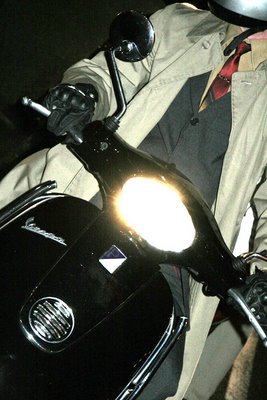
To view some of the pix from my latest personal photo project, " Scooteratti," click here to go to the Flickr set's thumbnails. Click on the right hand link for slideshow on a page.
Although these are " public" on Flickr, all rights are reserved. Feel free to pass the link to this blog to friends. But rights to post pix on your blog or website must first be requested from the photographer...moi!
Future uploads will include more pix from this weekend's Scooter Block Party, sponsored by the New York Scooter Club who throw a truly great event. Thanks guys! My newest project, four days old, seeks to explore the ties that bond scooter owners. This quirky and independent bunch live for the potholed roads of New York City and the smell of exhaust.
Saturday, June 10, 2006
Slivercast Video Content Distriubtion
 TotalVid
If you get your broadband from Verizon, have you noticed that little click through ad for TotalVid that is being presented by Verizon Online? I finally succumbed and clicked through today.
Remember a few months back when I speculated in a post that one of the future revenue paths for cross media producers would involve producing video clips for niche audiences to download for a price? Well check out TotalVid.
A frisky start-up this distribution " channel" for slivercast content features video downloads of more than 1,000 titles. A download costs up to $4 and expires after seven days, says CNET. " In a classic up-selling move, consumers can also purchase a DVD and permanent digital version of a movie and have the rental cost subtracted from the DVD buy."
Remember how I wrote that independent content producers might make future profits by producing niche content for example on subjects like.. say... woodworking? Well, TotalVid says that it "has the world's largest collection of the most popular Wood and Woodworking how-to videos available in our convenient download format. For as little as $2.99 you can download one of our top Wood and Woodworking how-to videos and begin viewing in just minutes. "
You can sign up here to have TotalVid consider distributing your content.
CNET CNET tells us that...
Start-up TotalVid, which sells specialty videos for sports and home-improvement enthusiasts, is tapping into growing consumer interest in easily distributed downloadable video.
....The download video service market is expected to grow in revenue from $1 billion in 2004 to about $5 billion by 2008, according to In-Stat. And though that number pales in comparison with the nearly $50 billion in annual revenues enjoyed by the movie industry, the download video market's growth is happening faster.
Friday, June 09, 2006
Weegee:F8 and Be There
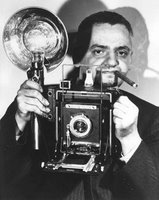
Weegee As Blogger?
After attending the ICP opening last night of Weegee's undiscovered photos , I decided to republish this post I wrote in March.
Reading all the tabloid buzz about the rape and killing of Imette St. Guillen, reminded me of Weegee, the photographer who invented a whole new genre for us photojournalists, even as he photographed murders. If Weegee were alive today he would take to blogging like a fish to water...posting his pix in real time. Instead of smoking cigars while souping his prints in hypo Weegee today would probably be found at the closest Starbuck's with a PC, uploading his pix using wireless.
Weegee, born in Poland in 1899, took the name Arthur Felig when he imigrated to New York with his family at nine. This freelance photographer worked out of the trunk of his car which he used as darkroom through the 30's and 40's as he photographed the daily dish of newsworthy images for tabloids and the wire services. Equipped with a police scanner he roamed the city in search of its darker side...its latest murders, fires or robberies.
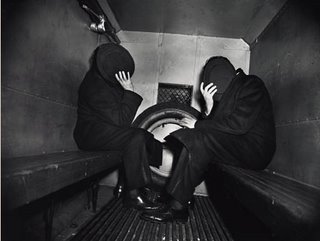
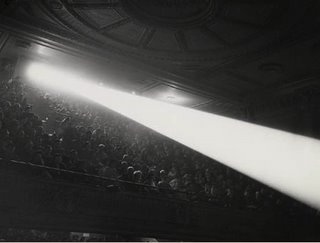 In my previous post I briefly mentioned Weegee's pix of people watching movies, Weegee's World: Movie Goers that this consumate voyeur took in theaters using infrared film, his subjects unaware. The Side Photographic Gallery collection of Weegee photographs includes photos in a slideshow, as well, some of which I have never seen before.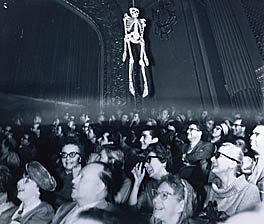
Untitled (In the Movie House Watching "Haunting of Hill House")
ca. 1950, Photo Copyright Arthur Felig
"He will take his camera and ride off in search of new evidence that his city, even in her most drunken and disorderly and pathetic moments, is beautiful."
- William McCleery in Naked City
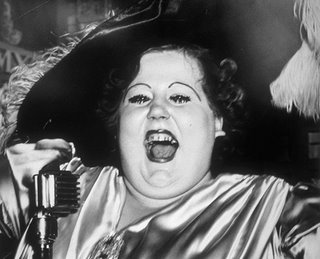
Sammy's Bowery Follies
When I read about Imette's last minutes at the Lower-East Side haunt the Falls, I thought of Weegee's Bowery Follies, where Weegee snapped pix breaks between photographing murders to catch scenes of humanity. The photos taken at Sammy's,
...was the scene of many of Weegee's most lighthearted and humanistic photographs, a great contrast to what was taking place on the street or curb or just outside the front door. The "poor man's Stork Club" became a refuge for Weegee, a safe haven allowing him to escape the blood and guts that his more salable photographs contained.
-Miles Barth
"F8 and Be There"
"F8 and Be There," Weegee was fond of saying. Using guide numbers for his flash he set the aperture on his Speed Graphic 4x5 press camera to insure enough depth of field to keep everything sharp. Stepping back he measured the space between his camera and the subject. Emotional distance was as important for Weegee as were the actual footsteps he had to take to insure that his pictures were properly exposed.
"His spontaneous, witty, and meaningful work went beyond that of a news photographer. He once said that he wished to show that ten and a half million people lived together in a state of total loneliness," Lee Gallery tells us.
As far as education, Weegee made it through the eighth grade. However, the family needed money and Weegee was needed to help work. He worked a lot of odd jobs: he helped his father with a push cart business, he even worked at a candy store for a while. It was when he had his picture taken by a street tintype photographer that he decided that this was what he was meant to do. Weegee often said that he was, 'a natural-born photographer, with hypo in my blood.' He quickly ordered a tintype outfit from a Chicago mail-order house, and after a few months he got his first job as a commercial photographer. After a few years he left the studio, due to a disagreement on what he should be paid. He then bought a second-hand 5x7 view camera and rented a pony from a local stable. He named the pony Hypo, and on the weekends when the kids were in their best clothes, he would walk around town putting kids on his pony and taking their picture. He would then develop the negatives, make prints, and go back to the families of the kids to try to sell them the photos.
Introduction to The Side Photographic Gallery collection of Weegee photographs
The web-site Weegee's World: Life, Death and the Human Drama was created in conjunction with the publication of Weegee's World by Miles Barth an exhibition at the International Center of Photography Midtown that was up from November 21, 1997 through March 8, 1998. It's worthy of a visit and proof that a web-site insures posterity for a " bricks and mortar" exhibition even after its photographs are taken down to make way for the next one.
Thursday, June 08, 2006
Brangelina Sells Toothpaste
 Illustration Copyright 2006 Gallery of the Absurd
Brangelina's new baby, Shiloh Nouvel Jolie Pitt? Wow. Now that's a name. Let's hope she doesn't plan on becoming a photographer. That name would never fit under a photo as a credit.
The baby's pix were leaked by bloggers before People and Hola Magazine were able to exercise their exclusive for which they paid millions of dollars for the right to post pix first, writes Daryl Lang at PDN Online in an update...yes an update on this HOT HOT HOT breaking story. Updated: Pitt-Jolie Baby Picture Leaks Online
Evidentally Shiloh's birth sells toothpaste as well as magazines. Crest Toothpaste sponsored this AP video clip online of IVillage of the birth in Namibia of Shiloh.
Feeling discouraged, as a cross media producer that all your earnest and worthy story pitches are going nowhere? Maybe you should throw a celebrity like Brangelina into the mix. Malaria...go talk to Sharon Stone. She donated money for mosquito nets which made it into the press worldwide.
According to this mysterious blogger ,Celebrities are Just Like Sea-Monkeys. Check out 14's great blog, Gallery of the Absurd , Gossip Fueled Art - Updated Weekly, created by this anonymous illustrator who calls herself simply 14, Fourteen.
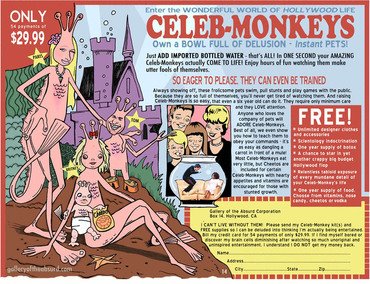
PDN tells us that....
The supposed prices People and Hello! paid for the photos were quickly leaked to The New York Post. In total, the photos could gross more than $10 million worldwide, widely believed to be the most ever paid for the rights to a photo shoot.
The Post's Page Six gossip column reported Tuesday that People spent $4.1 million for rights to the photos after winning an auction over the weekend held at Getty's New York office. Hello! magazine won the U.K. rights for $3.5 million, according to a Post story Wednesday by media reporter Keith Kelly. The story also said People settled for the North American rights only after offering $5 million for exclusive worldwide rights.
This gifted blogger, " 14" says in her bio
fourteen (14) has been an artist and a keen observer of the human species for centuries. Her irreverent underground art in the form of hand numbered and signed posters has been seen and collected throughout the West Coast for years and yet she has remained gleefully outside the radar of commercial success. She lives in San Francisco, CA.
Lately, she's been both fascinated and horrified by the alarming rise in celebrity culture. She noticed that everytime she flipped through a celebrity tabloid at the supermarket, she would erupt into tears of laughter and everyone standing in line to pay for their groceries would glare at her.
She always wanted to be a comic book artist, and here, in the pages of a glossy tabloid full of stalking paparazzi photos, catty commentary and the exposed bloated excess of celebrity existence, she had finally found the material to amuse and inspire her. And that is how Gallery of the Absurd was born.
The art shown here is created mostly by hand using ink, acrylic, pastels and oils on paper or canvas. Digital enhancement using Photoshop and Illustrator is also used occasionally. Original art is available and for sale. If interested, contact 14 at fourteencelebs@yahoo.com. She promises if you purchase her originals, you'll get a good return on your investment.
Wednesday, June 07, 2006
What is Podcasting? A Ninja's reply
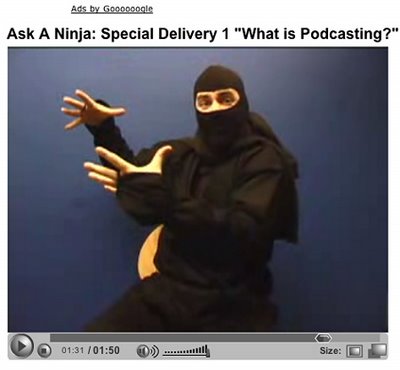
In February I wrote about the viral blitz of video downloads of the Saturday Night Live clip Lazy Sunday from YouTubes and how it helped launch this video sharing site into the Big Time. Now, if you are over age 12, you can go to YouTubes to learn from a Ninja all about podcasting.
Save yourself a lot of marketing dollars by clicking here Ask a Ninja: Special Delivery 1 "what is podcasting".
Tuesday, June 06, 2006
This Blogger Half-Naked...
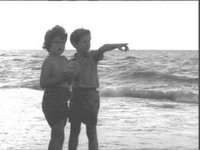
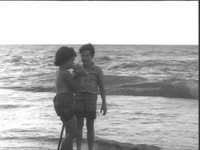
While trolling for links related to my brother Burnes for my last post I stumbled upon these photos of me half naked.
Yes. Only on the Internet. Half-naked, that's right. But before you get too excited you might want to know that I was only a kid and chubby too. So there you go...half-bare but hardly buff. In these pix I'm standing on the beach holding the conch shell that was given to me by a family friend, a fisherman named Manuel, who took us out on his sail-powered fishing boat from Fajardo Puerto Rico, on weekends.
The conch was used in Peter Brook's film Lord of the Flies, a family affair. My father served as director of photography while my brother played the role of Douglas and my mother was casting director and shot movie stills. Unfortunately I only got to play a stand in for Piggy in a test filmed by my father at the beach at the end of our street in Puerto Rico before the film began.
As I was chubby, I eminently suitable to play this part. Running down the beach with my brother I acted out the scene where Piggy discovers the conch shell and then blows it like a horn. Manuel had cut the tip off this shell for me with a hacksaw one time while we were sailing to Icacos, a reef-like islet just off Fajardo.
My father, a still photographer and early cross-media maven had never touched a movie camera before shooting this epic film. Peter Brook gave him nine days to learn. Hence these tests along the beach. In a future post for Father's Day I'll show you the ingenious track my father devised for filming on the beach and a swinging gate that panned with actors's movement.
You can read a synopsis of the scene I am acting out in these pix. In Golding's book it is called " The Sound of the Shell." Or click here to hear Alan Cheuse in NPR's All Things Considered, March 29, 2004 edition,
...review William Golding's Lord of the Flies, 50 years after its first publication. Cheuse says this harrowing tale of a group of schoolboys stranded on a remote tropical island still holds up today.
Online Biz Video
Last week my brother sent me this link to a great promotional video produced by by 2x4 about their multimedia design business. This clip is hosted on Apple's Quicktime Pro site and shows how dazzling the new QT7 codec truly is.
It's also a demonstration of how businesses in the future will promote themselves online. Read my previous post about Google's intention to become a one-stop shop for click-through ads.
It's also a demonstration of how businesses in the future will promote themselves online. Read my previous post about Google's intention to become a one-stop shop for click-through ads.
Google Video Ads
I'm baaack.
Read this interesting post today on video ads on Ken McCarthy's blog Looking at Video On the Web , an always informative blog that jogs me back to posting on my own blog.
Ken tells us:
As predicted on this blog last winter, Google is adding online video advertising to its pay-per-click arsenal - and it's happening this week.
Wow. So what else are those whiz-kids at Google thinking up? It's a no-brainer that they would begin to host video ads in the future as a one stop shop. For those of us that occasionally upload video clips to hosts for streaming, the user experience on the other end can prove varied as the player wars grind on in earnest.
In a previous post I linked to Google's video site to show a cool video clip about base jumping. Although the quality is funky it's easy to play.
At the time I thought Google's business was only about replicating the success of YouTube's model. No way. If Ken is right, it looks as if Google's video hosting service was the company's test drive for what may well prove to a lucrative venture.
I see a bright future ahead in which businesses promote themselves online with video clips such as this one by Guba, also featured on Ken's blog. What better way to get to know the services a firm provides than by hearing its owners speak on a video click-through ad?
For those of us cross-media producers struggling to support worthy documentary projects, producing video ads may prove a future source of subsidy. I have been dreaming of that day ever since I registered the URL www.streamingmessages.com three years ago.
 Here's Ken's post if you're too lazy to click through.
 Google pay-per-click video ads
Here's a super-short cheat sheet of what the service is going to look like:
1. It will be based on the winning pay-per-click model
2. The ads will appear as small, static boxes
3. The video plays only when the prospect clicks the static image
And here's the kicker... Google will host the video.
(If there's one group that has bandwidth to spare its the guys at Google!)
Saturday, May 27, 2006
Lake Malawi Calendar
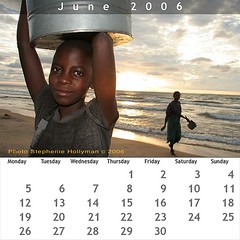
Photograph Stephenie Hollyman Copyright 2006
So here is my third calendar, for June. This time it is sized to fit inside a CD jewel case.
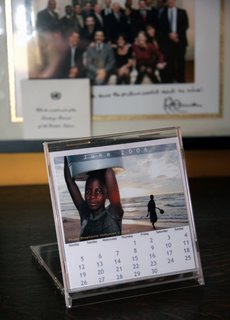 You can download this file at Flickr and print it out and then display it a nifty re-purposed CD jewel case, as described by Flagrant Disregard.
To download the customized calender created with the photograph I took in southern Africa last Spring of a young boy at dawn along the shore of Lake Malawi, click here and then go to the link above the photo for " all sizes". On the next page, choose " Normal size".
I used the Flagrant Disregard's Photo Calendar Maker to create this customized calendar from this photograph taken while I was documenting malaria for my project " Fever Zone."
Photo Flagrant Disregard Calendar Display Case Instructions
- To display your calendar in a CD jewel case
- Obtain a CD jewel case. You can buy empty jewel cases at your local computer store or order them online. Or you can recycle one of your existing jewel cases and store the CD it contained someplace else.
- Prepare the jewel case. First, gently remove the door of the jewel case, flip it around, and put it back on
- Then remove the cover insert. You can remove the back insert by gently prying up the disc tray.
- Print the calendar. Save the calendar image to your computer desktop. Then print it however you normally print images. Print it so that it is 4.75 inches wide (12 centimeters). This is 150 PPI if you savvy PPI. Calendars look best when printed on heavy matte photo paper.
- Final assembly. Cut out the printed calendar and insert it into your jewel case.
Tuesday, May 23, 2006
White House Photo Op

Have you ever wondered what it's like to cover the Whitehouse or the United Nations as a photographer? If you think it's exciting, you're wrong.
Play Pete Souza's great slideshow that brings you inside the Oval office with the addition of audio. Hear the cameras clicking.A White House Photo Op , online at the Chicago Tribune, surely proves that when natural sound is added to photographs it brings a story to life.
In my previous post Netizen Poynters Ken Irby Speaks, Kenny Irby of the Poynter Instutute answered my query about the power of audio when used with photography to tell a story.
The authenticity and emotional factors are increased by blending natural sound with still photographs. People are attracted by quality integration of audio and photojournalism. Both audio and still photography are powerful story telling structures, together they are extremely powerful and effective journalistic tools. The combination of a compelling photograph complimented by the natural voice of the individual explaining the context of their situation is arresting.
Monday, May 22, 2006
Of Bearded Tugboat Captains and Lighting
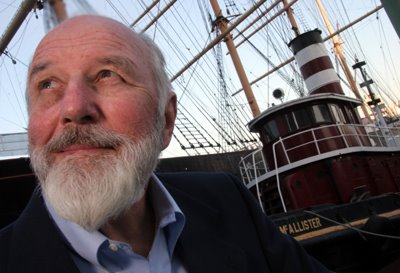 Photograph Copyright Stephenie Hollyman 2006
The bane of any photographer's existence is direct flash. Most of us like to shoot natural light during what Jay Meisel calls the "sweetlight" time of day.
But living in an imperfect world, most often we have to pop in a light or two. We then may have to break out lights, softbox, umbrellas and stands.
Sometimes we don't even have time for that, like in this picture I took last night of Captain Brian McAllister, standing in front of his company's 105 year old tugboat, the Helen McAllister at the South Street Seaport Museum. A real dynasty, McAllister Towing & Transportation is the only family-owned company remaining in New York harbor.
I used a nifty new gadget on my flash to take this picture.
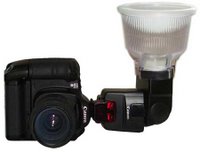 This Light Sphere II Inverted Dome Diffuser, invented by Gary Fong, which really does a pretty good job.
 But if you're shooting with a Canon, people do seem to turn reddish. So Gary Fong tells you to switch your camera's parameters to:
SETTINGS FOR CANON 10/20D
 Gary's recommendation for all Canon 10D/20d for greatest midrange detail and optimum workflow up to 10x15" prints is:
Parameter 1: SETUP:
- SIZE - Medium Stairstep
- SATURATION - MINUS 1
- CONTRAST - MINUS 2
- SHARPNESS - PLUS 2
- FLASH - E-TTL with no exposure compensation
- METERING MODE: Multizone (eyeball with two parenthesis)
Brian likes the way his new beard makes him look like his great great grandfather,
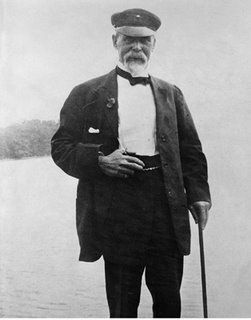 James McAllister who arrived from Ireland in 1864 and founded this company with a single sail lighter. Brian's wife, Rosemary, doesn't like his beard.
 Brian called me to take this photo before he shaved it off.
Brian's a friend and client for whom I have worked off and one over the years a freelance basis, writing and researching a book on his family's five generations in New York harbor. It's finished now, some 250-pages. In a later post I will give you chapters to download in PDF.
Subscribe to:
Posts (Atom)